

Share This Article
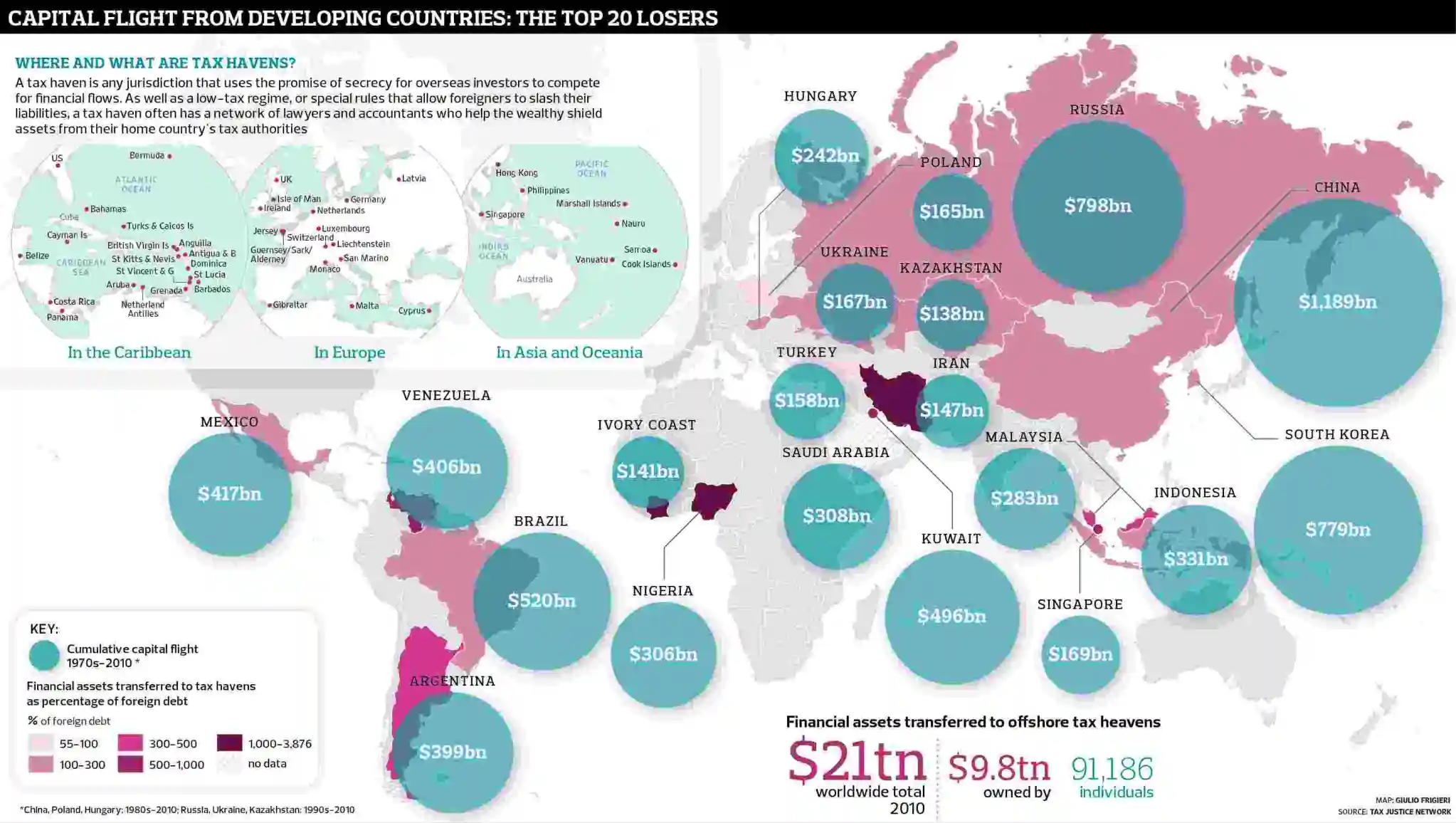
Capital flight to tax havens is a significant global issue impacting economies worldwide. This phenomenon involves the transfer of assets and income to offshore jurisdictions with low or no taxes, often to evade taxes and protect wealth.
This note explores data presented by Visual Capitalist and Atlas of the Offshore World, supplemented by other sources, to provide a comprehensive understanding of the scale, mechanisms, and implications of capital flight.
According to the Atlas of the Offshore World, the main tax havens for offshore wealth include Hong Kong, Switzerland, and Singapore, with Hong Kong holding about $2.8 trillion in offshore financial wealth. (Source)
A report by Global Financial Integrity (GFI) highlights that developing countries have lost $16.3 trillion since 1980. (Source)
Specifically, a study on capital flight in Africa found that the continent loses more money through capital flight than it receives in foreign aid.
This capital flight has significant opportunity costs, including missed investments and economic growth.
Capital flight also affects Western countries and is a significant phenomenon with profound economic and social implications.
Countries like the United Kingdom, the United States, and Germany have seen significant capital outflows to tax havens.
For example, the UK has lost billions of pounds in tax revenue due to capital flight to offshore jurisdictions like the Cayman Islands and Bermuda.
This capital flight represents a significant loss of resources that could have been used for development and, in poorer countries, increases the gap between classes and reduces funds available for public investments in infrastructure, education, and healthcare.
Everywhere, it exacerbates income inequalities and weakens the tax base, forcing governments to rely more on regressive taxes that disproportionately affect the poor.
Additionally, it creates an uneven playing field where multinationals and wealthy individuals can avoid taxes that small businesses and ordinary citizens cannot.
The Caribbean also hosts numerous tax havens known for their favorable tax laws and financial secrecy. Among the most notable are:
- Bahamas are famous for their absence of income, capital gains, and inheritance taxes, making them an attractive destination for individuals and companies looking to reduce their tax burden.
- British Virgin Islands offer a favorable tax environment with minimal taxes and strong financial privacy protection. They are one of the most popular destinations for setting up offshore companies.
- Cayman Islands impose no income, capital gains, or inheritance taxes, making them a top destination for investment funds and financial companies.
- Bermuda is another tax haven known for its absence of income and capital gains taxes. It is a popular destination for insurance and reinsurance companies.
- Panama is considered one of the most established and well-known tax havens in the Caribbean. Its legal and tax structure offers numerous advantages for offshore entities:
- No Taxes: Panama does not impose income, corporate, capital gains, or inheritance taxes on offshore entities operating outside the jurisdiction. This makes Panama extremely attractive for individuals and companies looking to minimize their tax burden.
- Financial Secrecy: Panama’s laws guarantee a high level of financial secrecy, protecting the identity of offshore company owners. This is a key factor attracting capital to the country.
- Operational Flexibility: Offshore companies in Panama can operate locally but are subject to local taxation in such cases. However, most offshore entities choose to operate exclusively abroad to avoid taxes.
In Asia, besides Hong Kong and Singapore, these countries can also be considered tax havens:
- Labuan, a federal territory of Malaysia, offers a low tax regime for offshore companies and financial services.
- Manila (Philippines) provides tax incentives for certain industries and has special economic zones with favorable tax conditions.
- Thailand: Has a territorial tax system, meaning foreign-sourced income is not taxed if it is not remitted to Thailand.
In the Middle East, several countries are known for their favorable tax regimes, making them attractive destinations for businesses and individuals looking to reduce their tax burdens.
Here are some notable tax havens in the region:
- United Arab Emirates (UAE), particularly Dubai and Abu Dhabi, is one of the fastest-growing tax havens. It offers no personal income tax and very low corporate taxes, attracting significant foreign investment.
- Bahrain imposes no personal income tax and has low corporate taxes. It is a significant financial hub in the region.
- Qatar offers a favorable tax regime with no personal income tax and low corporate taxes, making it an attractive destination for businesses.
- Oman offers tax exemptions for new businesses and does not impose personal income taxes. Source
- Kuwait does not impose personal income taxes and offers tax incentives for foreign investments.
There are also some tax havens in Africa:
- Mauritius is one of the main tax havens in Africa, known for its favorable tax laws and financial secrecy. Mauritius is a popular destination for multinationals and wealthy individuals looking to reduce their tax burden.
- Seychelles offers a favorable tax environment with low corporate taxes and strong financial privacy protection.
- Liberia has a lenient monetary system that attracts foreign investments, making it an emerging tax haven.
- Despite its economic inequalities, South Africa is a haven for those with the means to hide their capital.
- Botswana known for its favorable tax regime, which includes low corporate taxes and incentives for foreign investments.
- Namibia offers tax exemptions for new businesses and incentives for foreign investments. Source
- In Tunisia, there are several tax incentives designed to attract businesses and investments.
These countries have structured their tax policies to attract foreign capital, making them key players in the global network of tax havens.
Although the United States is often seen as a country with a strict tax system, some jurisdictions within the country function as tax havens:
- Delaware known for its favorable corporate laws and low taxation. Companies can benefit from very low corporate income tax and significant financial privacy. This state is home to over a million business entities, including many multinationals.
- Nevada offers similar advantages to Delaware, with minimal taxes and strong privacy protection for companies. It does not impose income taxes on individuals or corporations.
- South Dakota has become a haven for trusts due to its favorable laws offering asset protection and financial privacy. This state does not impose income, capital gains, or inheritance taxes.
- Wyoming offers similar advantages to Delaware and Nevada, with minimal taxes and strong privacy protection for companies. It does not impose income taxes on individuals or corporations.
- Alaska known for not having income taxes on individuals and corporations, as well as offering financial privacy protection.
- Florida does not impose income taxes on individuals, making it an attractive destination for individuals.
- Texas does not have income taxes on individuals, making it another attractive state for individuals.
In Europe:
- Switzerland known for its banking secrecy and low corporate taxes. It is a top destination for private wealth and corporate funds. Source
- Luxembourg offers a favorable tax regime for corporations, with low corporate income taxes and tax advantages for holding companies. It is a major destination for multinationals looking to reduce their tax burden. Source
- Netherlands known for its tax laws that favor multinationals, with tax agreements that significantly reduce income taxes. Source
- Ireland offers one of the lowest corporate tax rates in Europe, attracting many tech and pharmaceutical companies. Its favorable tax laws have made the country a popular destination for multinationals. Source
- Cyprus provides significant tax advantages for companies, with a relatively low corporate tax rate and numerous double taxation agreements. Source
- Malta known for its tax system that allows companies to obtain tax refunds, making the effective tax rate very low. Source
- Hungary has one of the lowest corporate tax rates in Europe, attracting many companies looking to reduce their tax burden. Source
Capital flight typically involves several mechanisms:
- Trade Invoice Manipulation: This involves under-declaring the value of exports or over-declaring the value of imports to move money across borders illicitly.
- Financial Transfers: Individuals and companies transfer funds to offshore accounts to benefit from lower taxes and greater financial privacy.
- Investments in Offshore Entities: Creating shell companies or trusts in tax havens to hold assets and income, thereby reducing taxes.
Efforts to combat capital flight include international cooperation on tax transparency and information exchange:
- Common Reporting Standard (CRS): An OECD initiative requiring the automatic exchange of financial information between participating countries to combat tax evasion.
- Foreign Account Tax Compliance Act (FATCA): A US law requiring foreign financial institutions to report accounts held by US citizens to prevent tax evasion.
- EU Directives: The EU has introduced various directives to increase tax transparency and reduce tax avoidance, such as the Directive on Administrative Cooperation (DAC6).
Additionally, civil society organizations and researchers advocate for greater accountability and reforms to reduce incentives for capital flight.
These include closing loopholes in tax laws, improving financial regulation, and increasing penalties for tax evasion.
Capital flight to tax havens is a complex issue with significant economic and social implications.
